1999 / 2000: Meeting the Challenge
Various forms of electronic cinema have been around for many years. Public demonstrations of modern day digital cinema, however, began in 1999 as an experimental effort privately funded by major motion picture studios. The block diagram below represents the typical trial digital exhibition system in the year 2000.
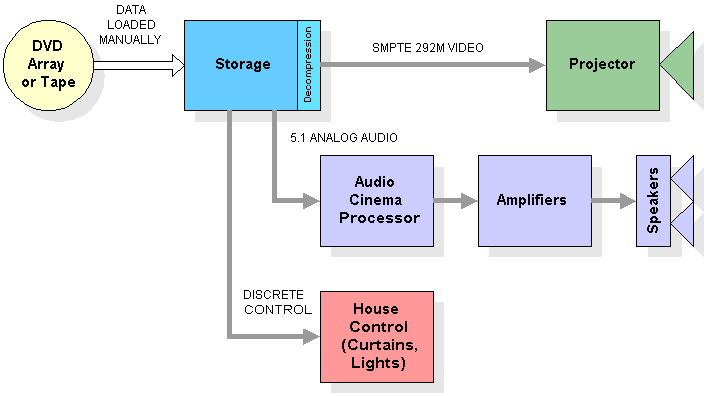
Phase 1: Early Trial Digital Cinema Systems
In the initial trial stage, the server used for storage and playout was a QuBit unit, manufactured by QuVis. The QuVis server is loaded with the digital movie from either discs or tape, compressed with a proprietary wavelet compression algorithm. Data is scrambled on the hard drive for protection. But digital image data sent to the projector was not protected. For early trial systems, no one seemed too concerned about the potential security risks of these systems, given that it would take a knowledgable person and a very expensive recorder to pirate the movie. (As it turns out, no digital thefts from the projection booth have ever been reported, and the patron with a digital camcorder has become the threat.) Security remained an issue, but one for a later phase.
Star Wars Episode I and An Ideal Husband were the first motion pictures to be released to the big screen in digital in June of 1999. Star Wars Episode I was displayed on four digital systems, two in Los Angeles, and two in New York. Two Hughes/JVC ILA-12K projectors, and two early prototype DLP-Cinema projectors from Texas Instruments were used for the Star Wars demonstrations. The digital demonstrations of An Ideal Husband were presented only on the Hughes/JVC ILA-12K. The ILA-12K produced a good looking picture, but was difficult to maintain in a day-to-day theatrical environment. The projector technology of choice quickly became DLP Cinema™ from Texas Instruments. In the early days, the only projectors available were prototypes built by TI. Later, TI licensed its technology exclusively to Barco, Christie, and Digital Projection. (The Digital Projection license later was acquired by NEC.) Sony entered the cinema projection market around 2004 with its SXRD LCOS technology.
Servers sourced digital audio as multiple AES/EBU (AES3) streams, requiring analog conversion for legacy audio processors. The servers also had the ability to command “house controls”, i.e., lights, masking, and curtains.
No improvements were made upon this system until the later half of 2001.
2001: Steps Forward
On July 17, 2001, a digital cinema milestone was crossed with the digital premiere of Jurasic Park III in Los Angeles. This particular presentation was compressed with a version of MPEG 2, as developed for digital cinema applications by Grass Valley Group. Called MPEG+, GVG’s compression was based upon the MPEG 2 decompression standard, making this the first public digital cinema presentation to use an almost standard decompression scheme. Within weeks, a true MPEG 2 presentation was held in New York for Tim Burton’s Planet of the Apes, this time using an Avica digital cinema server. Together, these presentations marked the beginning of a new phase for digital cinema by bringing new components to the scene.
A third server company, EVS, whose product is also based on MPEG, later jumped in with both Grass Valley and Avica to create interoperable servers. While a noble goal, it did not lead to true interoperability. GVG dropped out of the digital cinema game, and EVS and Avica were not able to demonstrate products that were fully interoperable. There was another layer to the problem: MPEG interoperability was a profitable goal for manufacturers, but for digital cinema, MPEG 2 has serious limitations in the eyes of many stakeholders. This was only one of several instances where the goals of stakeholders were ignored in favor of pushing profitable technology.
Security got a little boost during this period, though. TI and GVG developed a link encryption method, called Cinelink™ for the protection of the SMPTE 292 digital link between server and projector. While promoted by the server companies, it was not implemented in either of the GVG or Avica presentation mentioned above. Link encryption is pictured in the block diagram below.
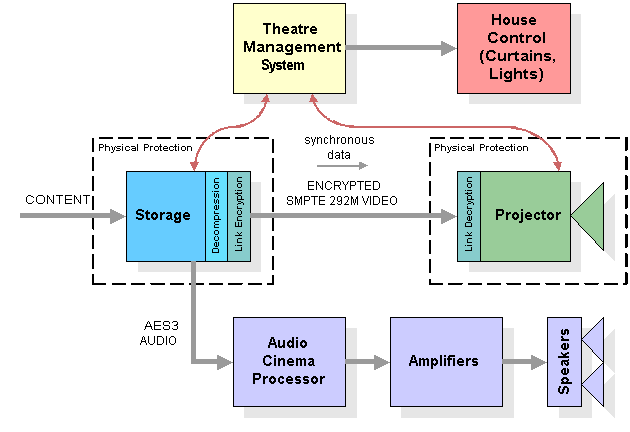
Phase 2: Link Encryption
Cinelink™ link encryption was introduced by Texas Instruments in their Mark VII version of the DLP Cinema projector. Link encryption encrypts the image data as it is sent to the projector, securing the data between server and projector. Full security, however, required encryption of the content stored on the server, which had yet to be introduced.
This phase began with the promise of file interoperability, but failed to deliver. It did produce link encryption, however, which was a step towards addressing the security issue.
2002: Introducing Security
By early 2002, digital cinema installations were numbered in the 40’s. They utilized several types of servers, including the QuBit, Avica, and EVS servers already mentioned, as well as the Technicolor Digital Cinema server designed by Qualcomm. These systems represented three different compression schemes, and four file formats. Interoperability was non-existent.
On May 16th, 2002, another digital cinema milestone was crossed with the digital release of Star Wars: Episode II. Although it stopped short of taking a financial stake in the deployment of digital projectors, Lucasfilm heavily promoted that its movie should be seen in digital. The strategy worked, and the digital installation count increased to over 100. The movie was released in all four digital formats — which proved to be a challenge all of its own.
Star Wars: Episode II broke ground by being the first digital movie released employing content encryption. Not all systems were capable of supporting encrypted content, but those employed by Boeing/Avica/EVS and Technicolor/Qualcomm were. The introduction of fully secure presentation systems was a major step forward.
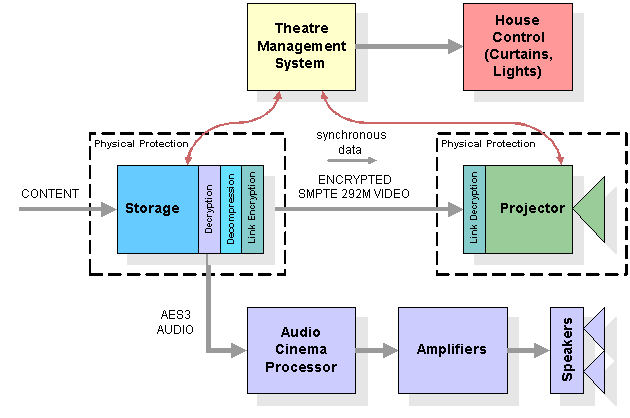
Phase 3: Full Security
Many thought this phase would signal a rollout of digital cinema. But numerous issues remained, the least of which were the many incompatibilities in data packaging, encryption, key manangement, and compression. Exhibitors now had enough experience to know that there were operational issues, too. To add to the problems, not all cinematographers, studios, and exhibitors thought the quality level was good enough to replace film. And the overriding issue remained: there wasn’t a viable business model. Studios stood to gain significant savings by substituting digital distribution for film distribution, and exhibitors stood to carry the financial burden of purchasing the new digital equipment that enabled it. While 3rd parties attempted to intermediate as system and service providers, none were successful. The core business partners, studios and exhbitors, had yet to speak.
To present a collective voice for the studios, Digital Cinema Initiatives LLC was created in early 2002. At first known as Newco Digital Cinema, DCI was a collaboration of the seven (now six) major motion picture studios.
Star Wars: Episode II created a bubble of expectation for digital cinema, and DCI was formed just as the bubble was about to burst. Stakeholders, both studios and exhibitors, needed to drive the development of this technology. Studios were concerned about potential reliance on proprietary technologies and associated licensing fees, while exhibitors were concerned about system functionality as well as cost. In July of 2005, DCI released its long awaited Digital Cinema Technical Specification. (In February of 2006, NATO followed with the release its Digital Cinema System Requirements.) Most significantly, also in 2005, the first Virtual Print Fee (VPF) agreements were signed with Access Integrated Technologies (Access IT, now Cinedigm) and Technicolor Digital Cinema, bringing forth the much needed means to subsidize the replacement of film projectors with digital projectors. With the bulk of the financing of new equipment now carried by studios, and with equipment emerging that was designed to meet (most) of DCI’s requirements, the digital cinema rollout began in late 2005.
(This information was originally posted at mkpe.com)